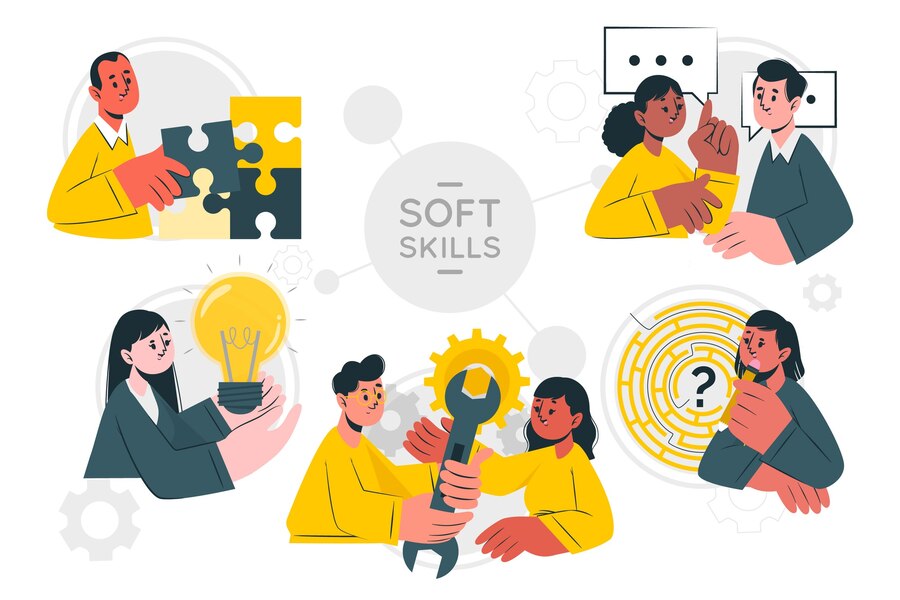
It’s not enough to have good technical skills to move up in your job; you also need to be able to work well with others. This is where soft skills, those crucial character attributes that enable you to successfully negotiate the challenges of any career, from effective communication to flexibility, come into play. To help you stand out, we’re here to provide some of the best examples of soft talents.
Soft Skills Employers Value

It position you as someone who can significantly impact a company’s culture and long-term performance, in addition to making you a valuable team member.
1. Resolving Conflicts
The skill of settling conflicts in a way that makes everyone feel heard and respected is known as conflict resolution. Interpersonal dynamics can make or break a situation in human resources, customer service, and management, so it’s a crucial talent.By addressing problems head-on yet diplomatically, mediating between opposing points of view, and attempting to find solutions that please all parties, you can put your conflict resolution abilities to use.
Study conflict resolution strategies, engage in active listening, and rehearse different situations to hone your strategy.
2. Paying Close Attention to Details
Another excellent example of a soft skill that employers value is attention to detail. It’s the capacity to identify even the tiniest mistakes, guaranteeing an accurate and superior job. Attention to detail is essential for jobs that need a high degree of precision, such as editing, accountancy, and architecture.
Show off this ability at work by double-checking your work, carefully going over paperwork, and taking a methodical approach to assignments. Use checklists to stay organized, concentrate on tasks that require accuracy, and push yourself to identify irregularities in your everyday routines to hone your attention to detail further.
3. Be patient
Maintaining composure under pressure is a sign of patience, which enables you to deal with problems successfully. In professions where challenging circumstances are frequent, such as education, nursing, customer service, and social work, this ability is essential.
Be patient at work by taking a methodical approach to tasks, allowing others the time they require, and maintaining composure under duress. To cultivate patience, engage in mindfulness exercises, handle stress with relaxation techniques, and establish reasonable expectations for both yourself and other people.
4. A Critical Observation
By paying attention to the small things that others might overlook, critical observation might result in better choices and solutions. Your ability to recognize and decipher minute details is essential if you work in quality control, data analysis, or investigative journalism.
Use this ability at work by carefully examining data, spotting trends, and offering solutions to challenging issues. Practice mindfulness, concentrate on jobs that require attention to detail, and ask for feedback on how well you perceive and understand details in your work to hone your critical observation skills.
5 . Listening Actively
Active listening entails giving the speaker your whole attention, hearing what they have to say, and intelligently answering. It’s critical in occupations where it’s necessary to comprehend and meet the needs of others, such as mental health counseling, education, sales, and customer service.
At work, you can show that you are actively listening by paying close attention to what is being said, asking clarifying questions, and offering comments that show you have understood.
How to Determine Which Soft Skills Are Needed for a Position
1. Look past the obvious. Soft talents are frequently included in job postings without being specifically mentioned. Words like “works well under pressure,” “manages multiple tasks,” or “strong communicator” highlight soft skills like communication, multitasking, and stress management.
2. Pay attention to your responsibilities. Examine the duties and responsibilities listed in detail. If the work entails managing a team, collaboration, leadership, and dispute resolution are essential.Still confused about which soft skills to put in the resume?
Then, feel free to avail our FREE 15-minute call with us.
Visit EnrichMyCareer for more information.
Frequently Asked Questions
1. What are the 7 major soft skills?
Communication, cooperation and teamwork, critical thinking and problem-solving, flexibility and adaptability, emotional intelligence, time management and organization, and leadership are the seven essential soft skills.
2. What are the 5 C’s of soft skills?
Soft talents are character traits and small actions people do to improve their life. These make it possible for people to engage with others in a productive and peaceful manner. Communication, creativity, teamwork, citizenship, and critical thinking are the five Cs of soft skills for students.
3. Which skill is best for the next 10 years?
As industries change, skills like artificial intelligence (AI), data science, cloud computing, digital marketing, and emotional intelligence—which combine technology and human expertise—will continue to be important.

A content writer with a passion for crafting engaging content. Dedicated to continuous learning and innovative, excels at adapting diverse writing styles.